How HRV Affects Your Focus (And How to Use It)
I started tracking my heart rate variability out of curiosity. I'd read that HRV was correlated with stress, recovery, and overall health. What I didn't expect was what it would teach me about focus.
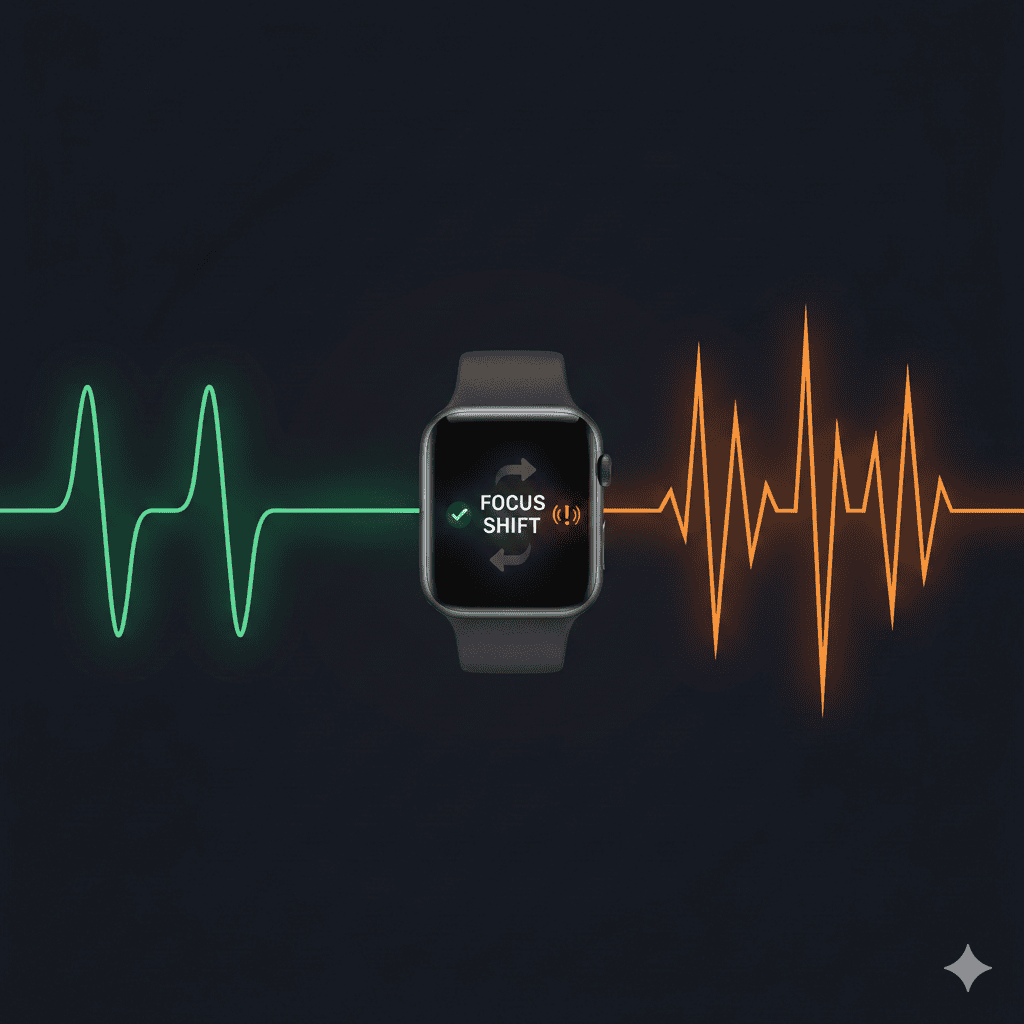
Three months into wearing my Apple Watch during work sessions, I noticed something strange: my HRV would shift before I consciously felt distracted. Not after—before.
It was like my body was signaling "you're about to lose focus" while my mind was still pretending to work.
What HRV Actually Is
Heart rate variability measures the variation in time between heartbeats. If your heart beats at 60 BPM, it's not actually beating once per second like a metronome. The intervals vary—maybe 0.9 seconds, then 1.1 seconds, then 0.95 seconds.
Higher variability generally indicates a relaxed, adaptable nervous system. Lower variability often indicates stress or fatigue.
This isn't about your heart rate itself. You can have a resting heart rate of 65 BPM with high HRV (good) or 65 BPM with low HRV (less good). The variability matters more than the absolute number.
For focus, this becomes interesting because HRV shifts in real-time based on your mental state.
The Pattern I Discovered
During my three months of tracking, I started correlating my HRV readings with my subjective sense of focus. What I found:
When deeply focused: HRV stayed relatively stable, often slightly elevated. My heart rate was calm, the intervals consistent.
Just before distraction: HRV would dip, often accompanied by a slight increase in heart rate. This happened 30-60 seconds before I reached for my phone or switched tabs.
During distraction: HRV dropped further. Even "relaxing" activities like scrolling social media showed lower HRV than actual focused work.
The last finding surprised me. I'd assumed checking my phone was a break—a moment of relaxation. The data suggested otherwise. The constant novelty-seeking actually created a low-grade stress response.
Why This Matters for Focus Training
The practical value isn't in the numbers themselves. It's in what they reveal about the connection between body and attention.
Most people think of focus as purely mental. You decide to concentrate, you concentrate. If you fail, it's a willpower problem.
But focus has a physical component. Your nervous system either supports sustained attention or it doesn't. When you're stressed, exhausted, or overstimulated, your body is in a state that makes focus harder—regardless of how much you "try."
HRV gives you a window into this. Not to obsess over numbers, but to notice patterns.
For me, the pattern was clear: when I was rested and started work without first checking my phone, my HRV was higher and my focus sessions went better. When I was tired or started the day with 20 minutes of scrolling, my HRV was lower and focus felt like pushing through mud.
Same person, same tasks—different physiological starting points.
How to Actually Use This
You don't need to stare at HRV charts all day. That would be its own form of distraction. But there are a few practical applications.
Check your baseline in the morning. Many apps show overnight or morning HRV. If it's significantly lower than your average, your capacity for demanding focus work might be reduced that day. This isn't an excuse to skip work—it's information about how to structure it.
Notice the pre-distraction signal. If you wear a watch during focus sessions, you might start to feel the moment before you get distracted. There's often a physical sensation—a slight restlessness, a change in breathing, something. HRV tracking helped me notice this because it gave me external validation that something real was happening.
Use it for feedback, not judgment. The goal isn't to achieve perfect HRV scores. It's to understand the conditions under which you focus best, and try to create those conditions more often.
I glance at my morning HRV to calibrate expectations for the day. I don't watch it during sessions—that would be distracting. But knowing "today is a lower HRV day" helps me be more strategic about when I tackle difficult work.
The Limitations
A few important caveats:
HRV is individual. My numbers mean nothing for you. What matters is your own baseline and trends, not comparison to anyone else.
Many factors affect HRV. Sleep, alcohol, illness, exercise, stress—all of these shift HRV. A single low reading doesn't necessarily mean anything about your focus capacity.
Consumer devices aren't medical-grade. Apple Watch, Oura Ring, Whoop—they provide useful approximations, not clinical measurements. Treat the data as directional, not definitive.
Don't over-optimize. The point isn't to gamify your HRV. It's to build awareness of the body-mind connection and use that awareness to work smarter.
Something to Try
If you have an Apple Watch or similar device, try this experiment:
For one week, note your morning HRV reading (many apps show this automatically). Then, at the end of each day, rate how your focus felt that day: 1-5, with 5 being "sustained focus came easily."
After a week, look for correlation. You might find that your subjective focus experience tracks more closely with HRV than you expected.
If it does, you've learned something useful: focus isn't just a choice you make. It's partly a function of your physiological state. And that state can be influenced—through sleep, through stress management, through how you start your morning.
What This Changed for Me
Understanding the HRV-focus connection shifted how I approach difficult work.
On high-HRV days, I front-load the demanding tasks. On low-HRV days, I do more administrative work or take recovery more seriously.
I also became more protective of my mornings. The data showed clearly that how I started the day affected my HRV for hours afterward. Scrolling first thing created a stress pattern that lingered. Starting with something intentional—even just 10 minutes of reading or a short walk—set a different baseline.
This isn't about chasing perfect metrics. It's about recognizing that focus has a physical foundation, and you can influence that foundation through the choices you make.
HRV tracking is a tool for self-awareness, not medical diagnosis. If you're concerned about your heart health or stress levels, consult a healthcare professional, not a wearable device.
Ready to rebuild your focus?
Start your 14-day free trial of FocusFit and train your attention with AI-powered coaching.
Download FocusFit